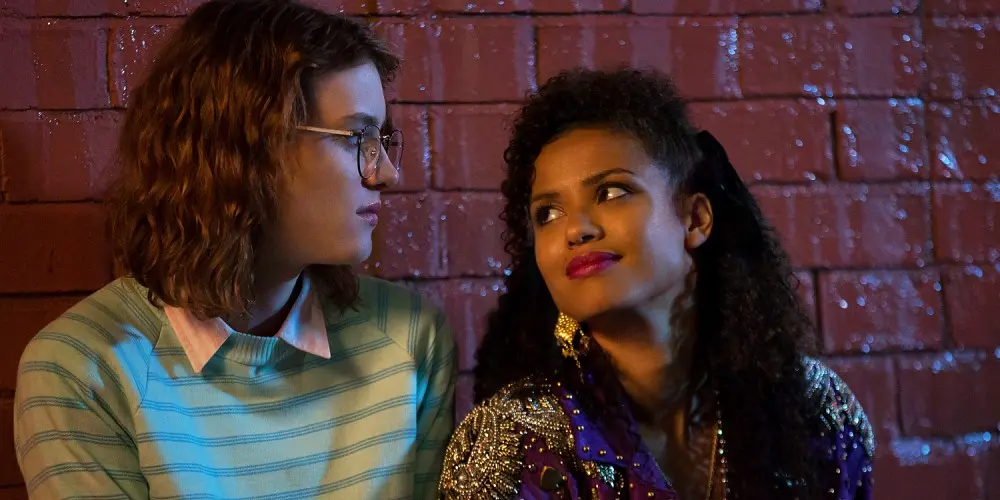
San Junipero
The premise
Yorkie and Kelly meet in San Junipero, a sun-drenched 1980s beach resort of neon bars, arcade games, and endless nights, all of it a simulation. In the real world they are elderly and dying; San Junipero lets the old visit as their younger selves a few hours a week, and lets the dying choose to stay forever by uploading their consciousness to a server farm after their bodies expire. The episode treats digital immortality not as horror but as a genuine, if unsettling, second chance: a cloud heaven where the dead keep dancing, fall in love, and decide for themselves whether living without end is paradise or a prison.
What the episode imagines
- 🔹❌Simulated afterlife
- 🔹❌Mind uploading
- 🔹❌Digital immortality
How close are we in 2026?
San Junipero needs two things we cannot do: read out the full structure of a specific human brain, and run it as conscious software. On the mapping side, 2024-2025 was a landmark stretch, but for tiny brains. In October 2024 the FlyWire consortium (Princeton's Mala Murthy and Sebastian Seung) published the first complete connectome of an adult fruit fly in a nine-paper Nature package: roughly 140,000 neurons and over 50 million synapses. In May 2024 Harvard's Jeff Lichtman and Google reconstructed a single cubic millimeter of human temporal cortex, about half a grain of rice: 57,000 cells, 150 million synapses, and 1,400 terabytes of data.
That last figure is the whole problem. A full human brain has roughly 86 billion neurons and on the order of 10^14-10^15 synapses. Scaling the 1mm-cubed pipeline to a whole brain means exabytes of imaging and validation that is simply infeasible with 2025 technology. Worse, current connectomes are of dead, sliced tissue; they capture wiring, not the live electrical and molecular dynamics that San Junipero would have to preserve.
The "digital afterlife" that actually shipped is far humbler and not really you. Griefbots and deadbots, Project December, HereAfter AI, StoryFile, Seance AI, are large language models fine-tuned on a person's texts, emails, and recordings. A 2025 Nature feature documented millions using them, and ethicists warn of unconsented "AI hauntings." Nectome still markets brain preservation but has emulated nothing. A 2025 expert survey put even functional digital minds at a 20% chance by 2030, 50% by 2050.
Key real-world developments
- First complete fruit-fly connectome
In October 2024 the FlyWire team mapped every neuron in an adult Drosophila brain, about 140,000 neurons and over 50 million synapses, published as a nine-paper Nature package, the most complex brain fully wired to date.
- Harvard and Google map 1mm-cubed of human brain
In May 2024 Lichtman's lab and Google reconstructed a grain-of-rice-sized slab of human cortex: 57,000 cells and 150 million synapses, generating 1,400 terabytes, showing how astronomically the data scales toward a whole brain.
- Griefbots ship, but they aren't you
Services like HereAfter AI, StoryFile and Seance AI build chatbots from a person's messages and recordings. A 2025 Nature feature reported millions of users and ethicists warning of unconsented 'AI hauntings' of the bereaved.
- Experts: digital minds are decades off
The arXiv State of Brain Emulation Report 2025 reassessed the field; a companion expert survey estimated only a 20% chance of functional digital minds by 2030, rising to 50% by 2050. Nectome has preserved brains but emulated none.
The verdict
San Junipero remains firmly science fiction, and honestly far off. We can now wire-map a fly and a sliver of human cortex, but a single cubic millimeter already produced 1,400 terabytes, and the technology to scale that to 86 billion neurons, or to run any of it as a living, conscious mind, does not exist. The 'afterlife' tech that is real, griefbots trained on your texts, mimics a person without preserving one. Experts give true digital minds a coin-flip chance only by mid-century. The dream of uploading yourself to a beach-town heaven is, for now, just that. Score reflects real connectomics progress against an immense remaining gap.
Sources
- NIH: Researchers fully map neural connections of the fruit fly brain (2024)
- MIT Technology Review: Google helped make an exquisitely detailed map of a tiny piece of the human brain (2024)
- Nature: Ready or not, the digital afterlife is here (2025)
- arXiv: State of Brain Emulation Report 2025
- Science/AAAS: Complete map of fruit fly brain circuitry unveiled (2024)
- Scientific American: Can AI 'Griefbots' Help Us Heal?
Reviewed and updated by the How Close to Black Mirror editorial team on 20 June 2026. Progress scores are reasoned editorial estimates based on the cited sources, not scientific measurements.