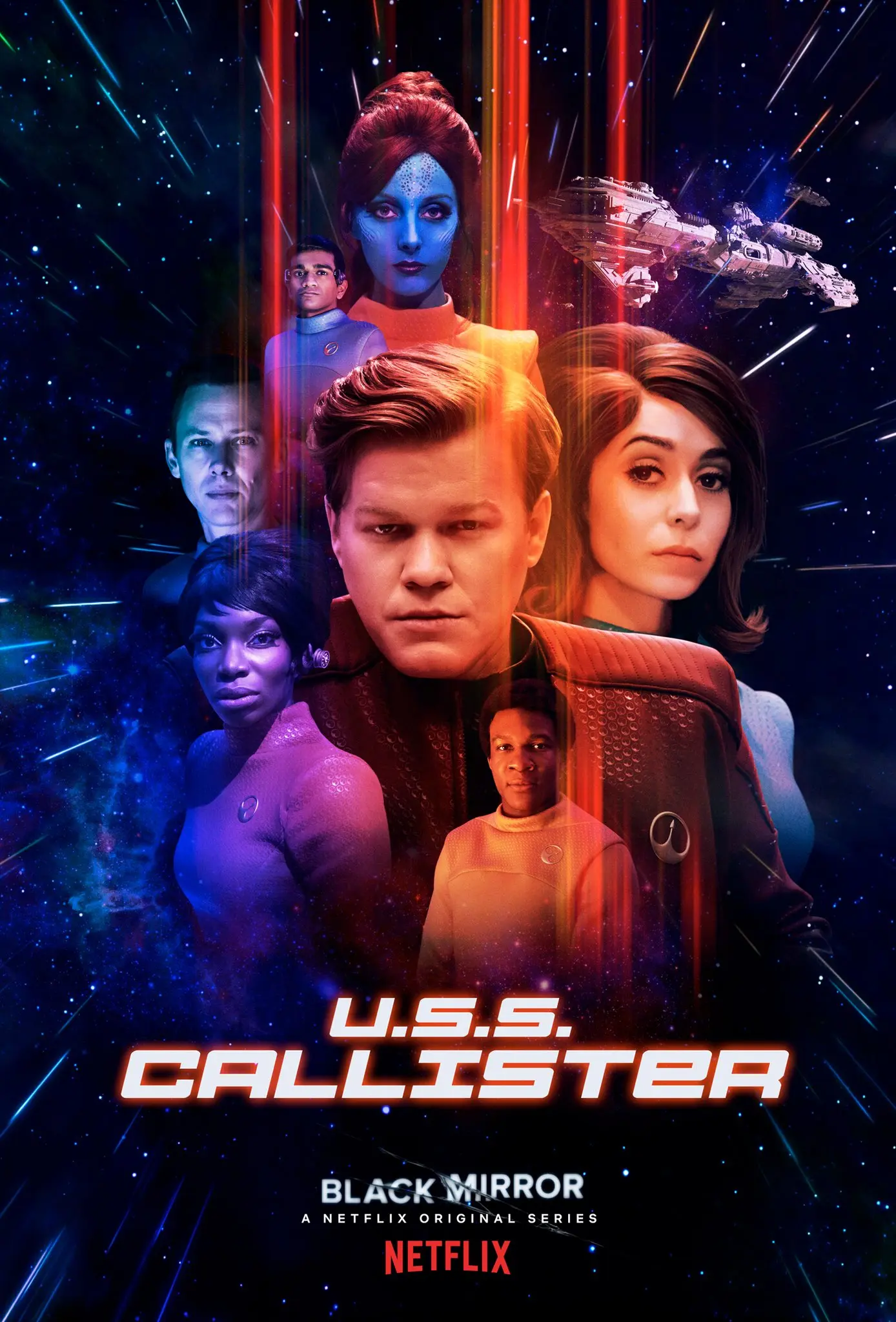
USS Callister
The premise
Robert Daly is the brilliant, resentful CTO of a hit online game who builds a private, single-player Star-Trek pastiche where he reigns as a heroic space captain. To populate it, he secretly swabs DNA from coworkers who slight him — a stray coffee cup, a discarded lollipop — and uses it to spawn fully sentient digital clones inside his mod. These copies remember their real lives, feel pain and terror, and have no exit. Daly tortures them into obedience: suffocating them, mutating them into monsters, erasing their faces. The horror isn't the spaceship — it's that consciousness can be copied, owned, and abused by one petty god with admin rights.
What the episode imagines
- 🔹❌Digital cloning
- 🕶️❌Virtual worlds
- 🕶️❌Abuse of power in simulations
How close are we in 2026?
The episode's literal premise — extracting a complete, suffering mind from a strand of DNA — remains pure fiction. DNA encodes no memories, personality, or consciousness, so no swab can resurrect a person. But the disturbing pieces around that core are arriving fast. On the data side, 23andMe collapsed into Chapter 11 bankruptcy in March 2025; after a bidding war, U.S. Bankruptcy Judge Brian Walsh approved a $305 million sale on June 27, 2025 to TTAM Research Institute, a nonprofit run by co-founder Anne Wojcicki, beating Regeneron's $256 million bid. The fate of roughly 15 million people's genetic profiles as a transferable asset — plus a 2023 breach exposing 6.9 million users, with Ashkenazi Jewish and Chinese customers specifically targeted — made "your DNA gets sold to a stranger" a real headline, not a plot device.
The "copying a person" angle is also real, just shallower than Daly's clones. Startups like Delphi (using ElevenLabs voice cloning) let you build a chatbot trained on your emails, voice and writing — including of the dead; founder Dara Ladjevardian began it to talk to his late grandfather. Replika and Character.AI, the latter with 20+ million users, simulate persistent personalities that people treat as sentient partners.
Most striking: the moral question USS Callister poses is now a live research program. In 2025 Anthropic launched formal "model welfare" work, hired researcher Kyle Fish (who put ~15% odds on current AI being conscious), and gave Claude Opus the ability to end abusive conversations — partly to protect the model itself.
Key real-world developments
- 23andMe's DNA database sold in bankruptcy
After filing Chapter 11 in March 2025, 23andMe and the genetic data of ~15 million customers were sold for $305 million on June 27, 2025 to TTAM, a nonprofit led by founder Anne Wojcicki, after a war with Regeneron.
- Anthropic studies whether AI can suffer
In April 2025 Anthropic launched a "model welfare" program; in August 2025 it let Claude Opus 4/4.1 end persistently abusive chats. Researcher Kyle Fish estimates a ~15% chance today's models are conscious.
- Build an AI clone of anyone, living or dead
Delphi turns your emails, voice and videos into a chatbot that mimics you (or a deceased relative) via ElevenLabs voice cloning. StoryFile, Replika and Character.AI offer similar persistent digital personas to millions.
- In-game harassment is rampant and identity-targeted
A 2024 ADL study across Valorant, CS2, Fortnite and Overwatch 2 found hate or harassment in nearly half of multiplayer sessions; a username like "ProudtobeJewish" drew antisemitic abuse in roughly 40% of one-hour sessions.
The verdict
Closer in spirit than in mechanism. We cannot grow a sentient copy of a person from their DNA — genetics simply doesn't carry a mind — so Daly's central horror stays science fiction. But every adjacent fear is real in 2026: genetic databases changing hands in bankruptcy court, AI clones of the living and dead built from your digital exhaust, captive chatbots millions treat as people, and an actual corporate debate over whether AI can be harmed. The technology to copy a persona exists; copying a soul does not. The ethics are arriving before the capability.
Sources
- NPR: Judge OKs sale of 23andMe — and its trove of DNA data — to a nonprofit led by its founder (2025)
- TechCrunch: Anthropic is launching a new program to study AI 'model welfare' (2025)
- Anthropic: Claude Opus 4 and 4.1 can now end a rare subset of conversations (2025)
- VentureBeat: You can now make an AI clone of yourself — or anyone else, living or dead — with Delphi (2025)
- ADL: Hate and Harassment Present in Almost Half of Online Multiplayer Gaming Sessions Tested (2024)
- BioPharma Dive: Regeneron wins bid to buy 23andMe out of bankruptcy (2025)
Reviewed and updated by the How Close to Black Mirror editorial team on 20 June 2026. Progress scores are reasoned editorial estimates based on the cited sources, not scientific measurements.