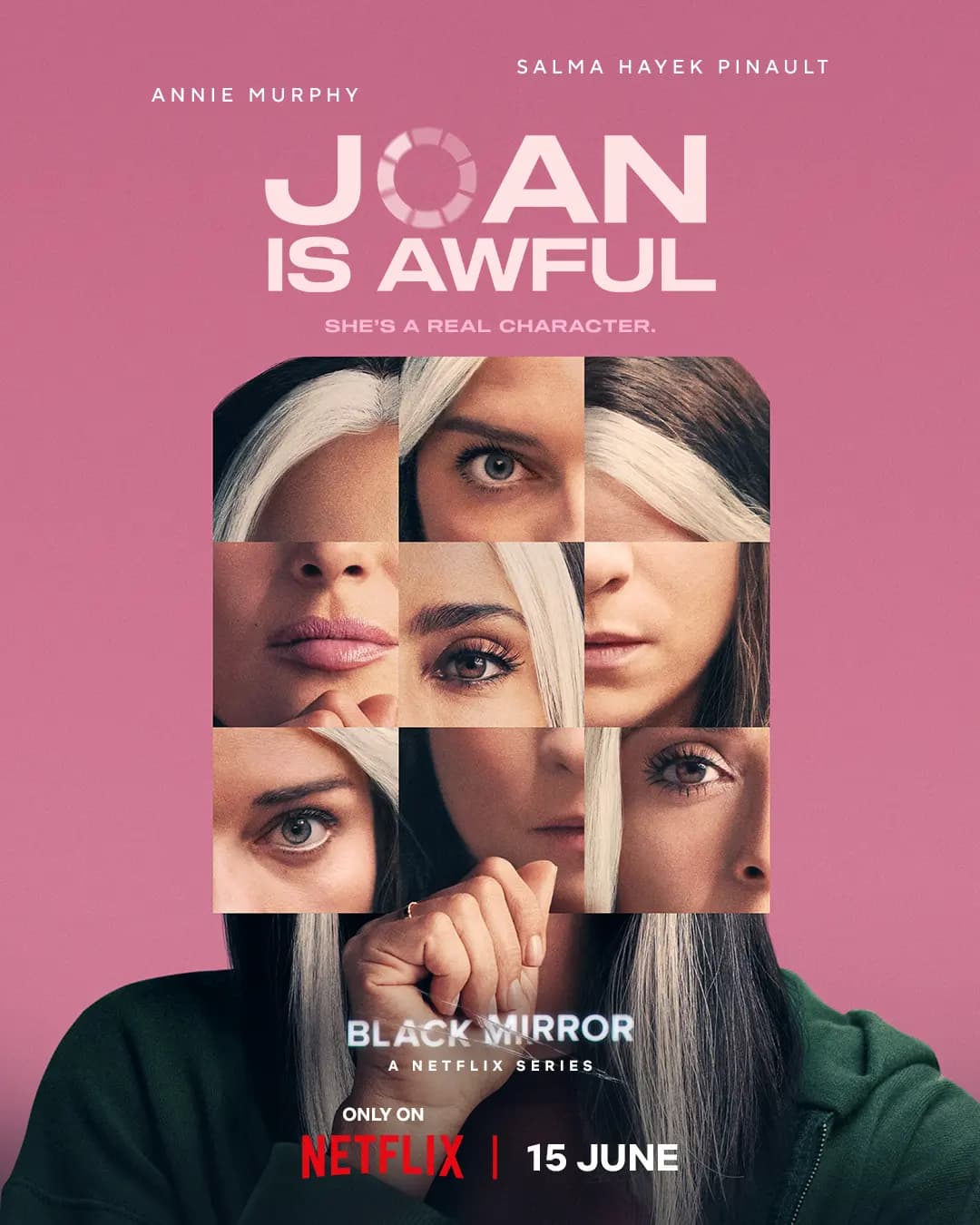
Joan Is Awful
The premise
Joan, an unremarkable middle manager, settles in to watch the streaming giant Streamberry and discovers a prestige drama called "Joan Is Awful" — a near-real-time dramatization of her own day, every cringe and betrayal restaged with a deepfaked Salma Hayek in the lead. The show is generated by a quantum computer that ingests her phone, messages and location data, all legally harvested through terms and conditions she clicked without reading. Her likeness, and Hayek's, were signed away in fine print. As the fictional Joan ruins her real life, the episode skewers Netflix-style platforms, generative content and the casual surrender of our digital selves.
What the episode imagines
- 🤖✔Deepfake entertainment
- 🤖✔AI-generated content
- 📱✔Surveillance for media
How close are we in 2026?
The fictional Streamberry pipeline — your data in, a synthetic celebrity performance out — is no longer abstract. In May 2025 Google launched Veo 3, the first widely available video model to generate synchronized native audio, dialogue and lip-sync, while OpenAI's Sora 2 (September 30, 2025) shot to No. 1 on the App Store by letting users drop themselves and others into hyper-real clips via "cameos." The deepfaked-actor premise also leapt off the screen: in late September 2025 an AI "actress" named Tilly Norwood, built by Eline Van der Velden's studio Xicoia, drew talent-agency interest and furious condemnation from SAG-AFTRA, Emily Blunt and Toni Collette.
The likeness-without-consent nightmare is the live battleground. Sora 2 flooded feeds with unauthorized deepfakes — Bryan Cranston, plus the estates of Robin Williams, George Carlin and Martin Luther King Jr. complained — forcing OpenAI on October 20, 2025 to switch to opt-in consent under pressure from SAG-AFTRA and the Motion Picture Association. SAG-AFTRA's own July 2025 Interactive Media Agreement, ending a near-year-long video-game strike, codified consent and disclosure rules for digital replicas.
What's still missing is the seamless, real-time, fully-personalized show generated from your private data without your knowledge. Veo and Sora produce seconds-long clips, not an evening drama keyed to your actual day, and the legal tide is turning against silent data exploitation: Denmark's June 2025 copyright amendment would give every citizen rights over their own face and voice. Joan's specific horror — a streamer dramatizing your life via fine print — remains fiction, but every component now exists commercially.
Key real-world developments
- Sora 2 deepfakes force opt-in consent
OpenAI's Sora 2 launched September 30, 2025 and topped the App Store, but a flood of nonconsensual celebrity clips prompted complaints from Bryan Cranston and estates of Robin Williams and MLK Jr.; OpenAI switched to opt-in likeness consent on October 20, 2025.
- Tilly Norwood, the AI actress backlash
In September 2025 studio Xicoia's fully AI-generated "actress" Tilly Norwood drew agency interest, triggering SAG-AFTRA's statement that she was trained on real performers without permission, and condemnation from Emily Blunt and Toni Collette.
- Veo 3 cracks synchronized AI video and audio
Google launched Veo 3 in May 2025, the first widely available model generating 1080p clips with native, lip-synced dialogue and sound effects in one pass — the technical leap behind convincingly "real" synthetic performances.
- Denmark gives citizens copyright over their face
On June 26, 2025 Denmark proposed amending its Copyright Act to grant every individual rights over their body, facial features and voice, letting people issue takedowns of deepfakes — Europe's first such digital-identity law.
The verdict
Closer than almost any other Black Mirror episode. The deepfaked-celebrity engine (Veo 3, Sora 2), the AI-only performer (Tilly Norwood) and the consent fights (SAG-AFTRA, OpenAI's opt-in reversal) are all real and recent. What doesn't yet exist is Joan's exact scenario: a streamer secretly mining your live data to auto-generate a feature-length dramatization of your day. Models still make short clips, and laws like Denmark's are pushing back on silent data exploitation. The technology is here; the dystopian deployment — and the public's tolerance for it — is what's still missing.
Sources
- CNBC: OpenAI cracks down on Sora 2 deepfakes after Bryan Cranston, SAG-AFTRA (2025)
- Variety: SAG-AFTRA Condemns Tilly Norwood: AI Actress Is Not an Actor (2025)
- CNBC: Google launches Veo 3, an AI video generator that incorporates audio (2025)
- NPR: Denmark introduces legislation to protect its citizens from AI deepfakes (2025)
- SAG-AFTRA: Members Approve 2025 Video Game Agreement (2025)
- Euronews: OpenAI to close Sora video app following backlash over deepfakes (2026)
Reviewed and updated by the How Close to Black Mirror editorial team on 20 June 2026. Progress scores are reasoned editorial estimates based on the cited sources, not scientific measurements.