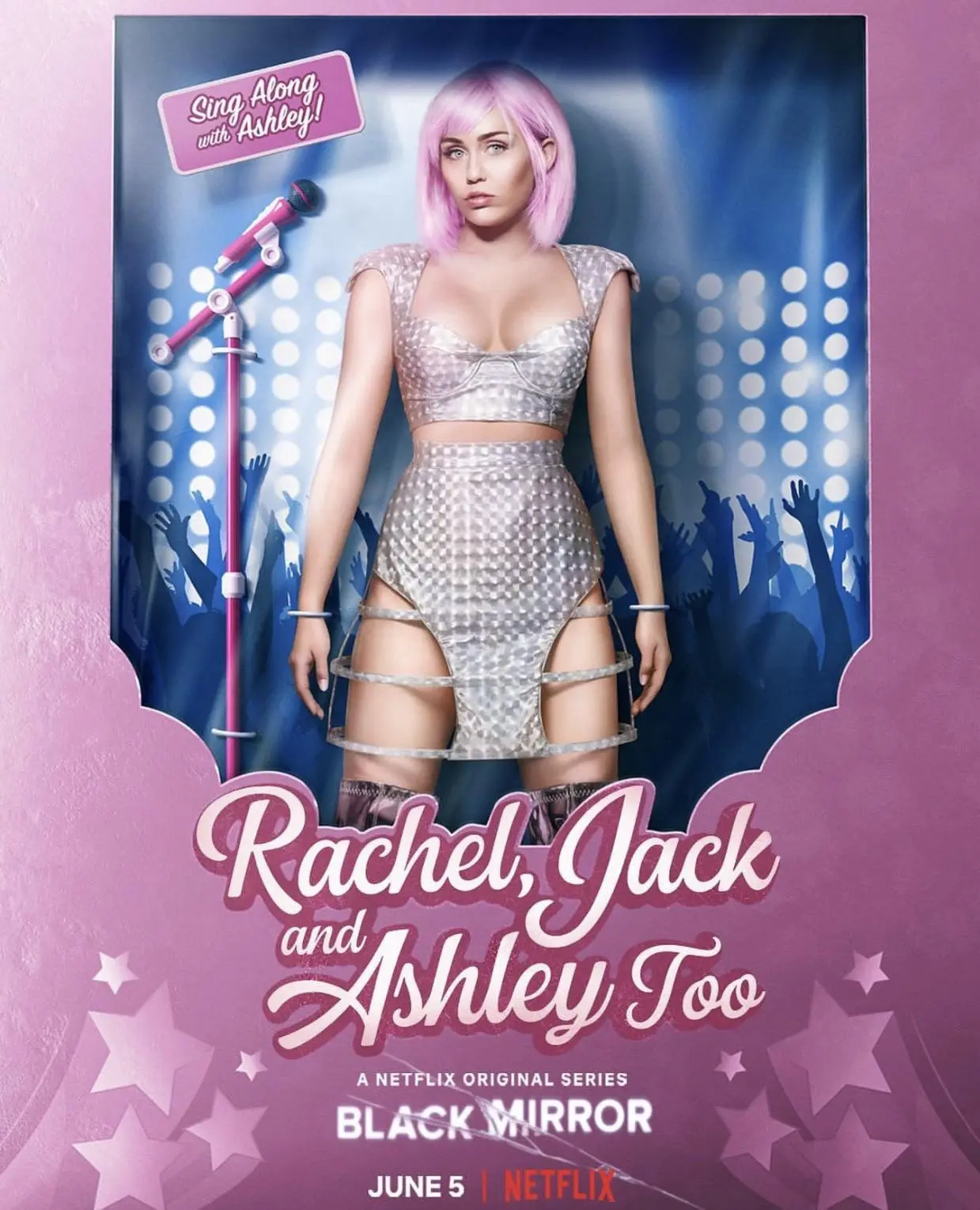
Rachel, Jack and Ashley Too
The premise
Pop star Ashley O (Miley Cyrus) is the perfect product: bubbly, prolific, and totally controlled by her aunt-manager. When Ashley resists the formula and slips into a coma, her handlers don't mourn the cash cow — they keep monetizing her. They unveil a holographic concert version, then plan to mine her comatose brain for unreleased songs and eventually launch a fully synthetic Ashley who never talks back. Meanwhile a lonely teenager, Rachel, owns 'Ashley Too,' a chirpy AI doll built from the star's personality. The episode imagines a music industry where an artist's voice, face and creativity outlive — and outvalue — the human who made them.
What the episode imagines
- 🤖✔AI celebrity assistants
- 🔹✔Digital exploitation
- 🔹✔Synthetic personalities
How close are we in 2026?
The 'keep selling the star without the star' business is now real. Since May 2022, ABBA Voyage has staged motion-captured digital avatars of the band circa 1979 nightly in a purpose-built London arena; by late 2025 it had sold roughly 3.5 million tickets, and developers are building a New York venue slated to open around 2028. Holographic and AI revivals of dead and living musicians have moved from novelty to a licensing category.
The synthetic-vocals threat arrived in April 2023 with 'Heart on My Sleeve,' an anonymous track faking Drake and The Weeknd that Universal Music Group scrambled to pull from Spotify, Apple Music and TikTok. By 2024, the major labels sued AI generators Suno and Udio for $500 million-plus over training on copyrighted recordings — then pivoted to deals: Universal settled with Udio in October 2025 and Warner with Suno in November 2025, agreeing to license catalogs for new AI tools launching in 2026 (Suno also bought Songkick from Warner). The American Federation of Musicians promptly sued UMG and Warner, arguing the settlements compensate labels, not the musicians whose voices were used.
Lawmakers are racing the technology. Tennessee's ELVIS Act took effect July 1, 2024, adding 'voice' to publicity rights. California's AB 1836 (2024) bars AI replicas of dead performers without estate consent. Federally, the TAKE IT DOWN Act — targeting nonconsensual deepfakes — was signed May 19, 2025, while the broader NO FAKES Act, backed by YouTube and OpenAI, stalled again.
Key real-world developments
- ABBA Voyage normalizes the avatar concert
ABBA's London hologram show passed roughly 3.5 million tickets by late 2025, sold about 1.06 million in 2024 alone, and is being copied — developers are building a dedicated New York venue targeting a 2028 opening.
- Fake Drake and the AI-music gold rush
The 2023 deepfake track 'Heart on My Sleeve' faking Drake and The Weeknd triggered $500M label lawsuits against Suno and Udio, which by late 2025 flipped into licensing deals for AI music platforms launching in 2026.
- Tennessee's ELVIS Act protects voices
Effective July 1, 2024, the ELVIS Act made unauthorized commercial use of a recognizable voice a Class A misdemeanor and lets artists sue makers of tools whose 'primary purpose' is cloning their voice.
- Estates fight AI resurrection
California's AB 1836 (2024) requires estate consent for AI replicas of dead performers. In 2025 SAG-AFTRA filed a labor charge over an AI James Earl Jones voicing Darth Vader in Fortnite without bargaining.
The verdict
Eerily close on the commercial machinery, not yet on the sci-fi. The holographic touring star (ABBA Voyage), the convincing AI voice clone (Fake Drake), labels monetizing artists' synthetic likenesses, and a wave of voice/likeness laws (ELVIS Act, AB 1836, TAKE IT DOWN) all exist in 2026. What's missing is the episode's literal premise: extracting unreleased songs from a comatose brain and a personality-complete AI doll. The business incentive to keep selling a star who can't object is fully real; the neurotech to manufacture one from scratch is not.
Sources
- Billboard: AI Music Timeline — From 'Fake Drake' to Suno & Udio Settlements (2025)
- Hollywood Reporter: AFM Sues UMG, WMG Over Suno and Udio Settlements (2025)
- Davis Wright Tremaine: Tennessee Passes ELVIS Act on AI Voice Replicas (2024)
- Fenwick: California's New AI Laws Limit Uses of Digital Likeness (2024)
- Latham & Watkins: President Trump Signs TAKE IT DOWN Act Into Law (2025)
- Billboard: NO FAKES Act Returns to Congress With YouTube, OpenAI Support (2025)
Reviewed and updated by the How Close to Black Mirror editorial team on 20 June 2026. Progress scores are reasoned editorial estimates based on the cited sources, not scientific measurements.