Eulogy
The premise
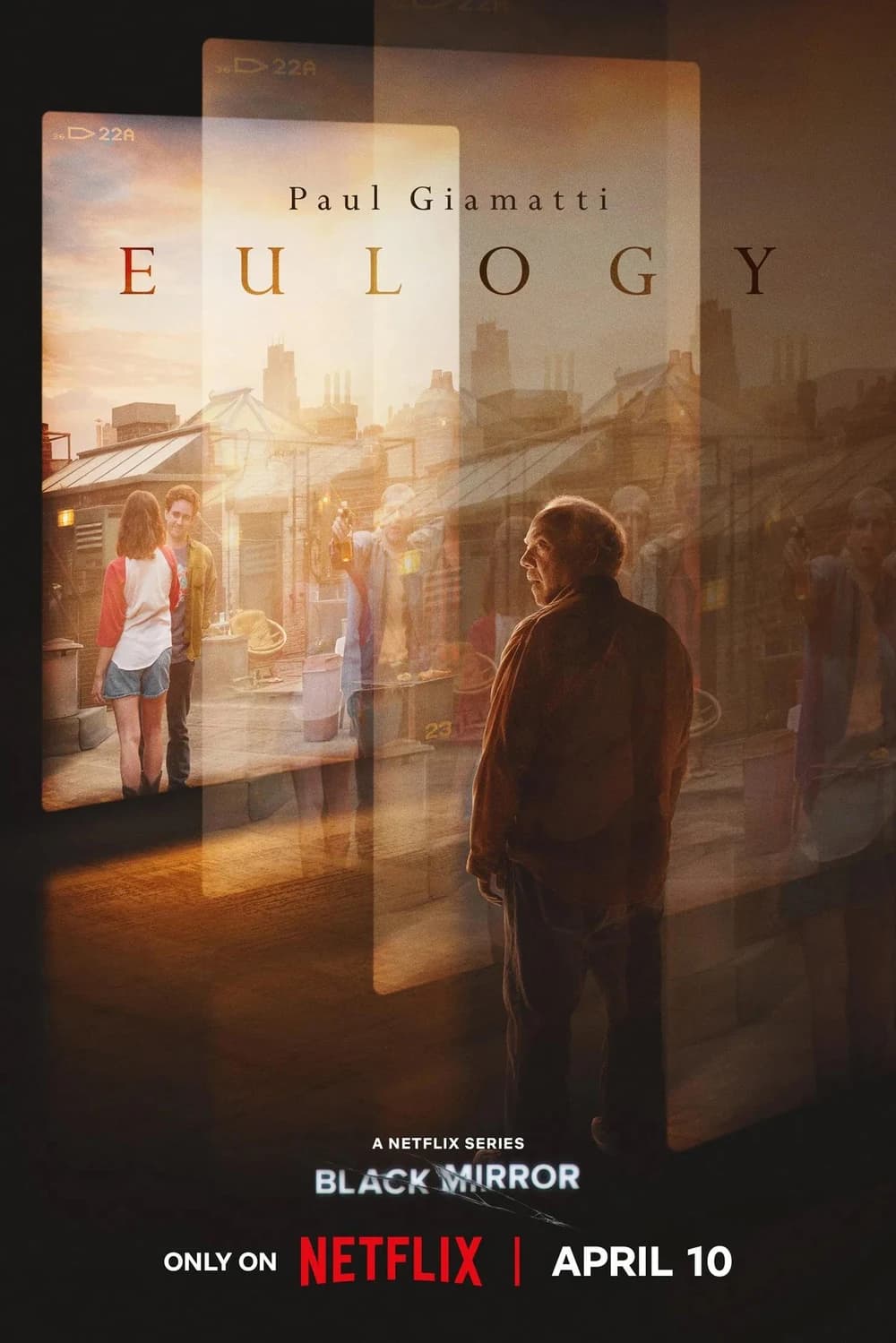
A grief-stricken loner, Phillip (Paul Giamatti), is contacted by a company called Eulogy: a woman he once loved, Carol, has died, and her family wants his memories for an immersive memorial. A drone drops a kit with a tiny nodule he presses to his temple. Suddenly he can physically step inside his old still photographs, walking around frozen 3D moments while a calm AI "Guide" coaxes him deeper, asks him to turn faces toward the camera, and reconstructs scenes he'd half-buried. As he explores the reconstructed past, the system surfaces jealousy, misunderstanding and regret. The technology promises a richer eulogy; what it really excavates is the truth he avoided.
What the episode imagines
- 🧠❌Immersive memory recall
- 🔹❌Holographic reconstruction
- 🔹❌Digital nostalgia
How close are we in 2026?
The literal magic of "Eulogy" is stepping bodily into a flat photo and looking around. In 2025 that stopped being pure fantasy. At WWDC in June 2025 Apple announced visionOS 26, released that September, with "Spatial Scenes": on-device generative AI that converts an ordinary 2D photo into a multi-perspective scene you can lean into and peer around inside Vision Pro, surfaced in Photos, the Spatial Gallery and Safari, with a developer API. Meta shipped the same year-of-3D energy: Horizon Hyperscape Capture entered early access on Quest 3/3S, letting users scan a room in minutes into a cloud-streamed, photorealistic 3D Gaussian-splat world you can walk back into.
The underlying tech is real and fast-moving. 3D Gaussian Splatting and NeRFs now reconstruct explorable 3D from ordinary images, with real-time rendering and Niantic's Scaniverse open-sourcing a compact .SPZ format roughly 90% smaller than PLY. Tellingly, the episode's own VFX (per American Cinematographer) leaned on photogrammetry and 3D reconstruction to build its walkable photo-worlds. Animating the dead is also mainstream: MyHeritage's Deep Nostalgia (D-ID tech) has brought millions of still faces to life since 2021.
What's missing is the seamless, single-photo, full-room reconstruction with an emotionally intelligent AI guide. Today's tools either fake parallax around one photo (Apple) or need many images / a live scan (Meta, splatting). Stitching sparse old snapshots into one continuous, navigable memory remains beyond consumer reach.
Key real-world developments
- Apple turns 2D photos spatial
visionOS 26, shown at WWDC June 2025 and released September 2025, uses generative AI "Spatial Scenes" to add depth to flat photos so Vision Pro users can lean in and look around them in Photos, the Spatial Gallery and Safari.
- Meta lets you walk into scanned rooms
Meta's Horizon Hyperscape Capture launched in early access in 2025, scanning a real room in minutes into a cloud-streamed, photorealistic 3D Gaussian-splat world explorable on a standalone Quest 3, now with multiplayer.
- Gaussian splatting becomes 3D's JPEG
In 2025 3D Gaussian Splatting and NeRFs moved into production: real-time rendering on consumer headsets and Niantic's Scaniverse open-sourcing the .SPZ format, about 90% smaller than PLY, to stream photoreal scenes on phones.
- Cambridge warns of grief-tech "deadbots"
In May 2024 Cambridge's Leverhulme Centre warned that AI "deadbots"/"griefbots" recreating the departed could psychologically "haunt" the bereaved, urging consent rules and dignified "retirement" rituals for digital afterlife services.
The verdict
Closer than you'd think on the visuals, further on the soul. By 2026 you can genuinely step into a 3D photo-world: Apple fakes depth around a single snapshot, while Gaussian splatting and Meta's Hyperscape build walkable photoreal scenes from scans. But reconstructing a navigable memory from a handful of decades-old prints, narrated by an AI that reads your emotions and probes your evasions, doesn't exist. The grief-tech industry and its ethical alarms (Cambridge's "deadbots") are very real. We have the rendering; we lack the seamless reconstruction and the unnervingly perceptive Guide.
Sources
- Apple Newsroom: visionOS 26 introduces powerful new spatial experiences (2025)
- UploadVR: Hands-On with Meta Horizon Hyperscape on Quest 3 (2025)
- American Cinematographer: Black Mirror "Eulogy" VFX (2025)
- University of Cambridge: Call for safeguards against AI 'deadbot' hauntings (2024)
- Slate: The Uncanniness of a Grieving Mother Meeting Her Dead Daughter in VR (2020)
- BBC News: MyHeritage Deep Nostalgia reanimates old photos (2021)
Reviewed and updated by the How Close to Black Mirror editorial team on 20 June 2026. Progress scores are reasoned editorial estimates based on the cited sources, not scientific measurements.