Playtest
The premise
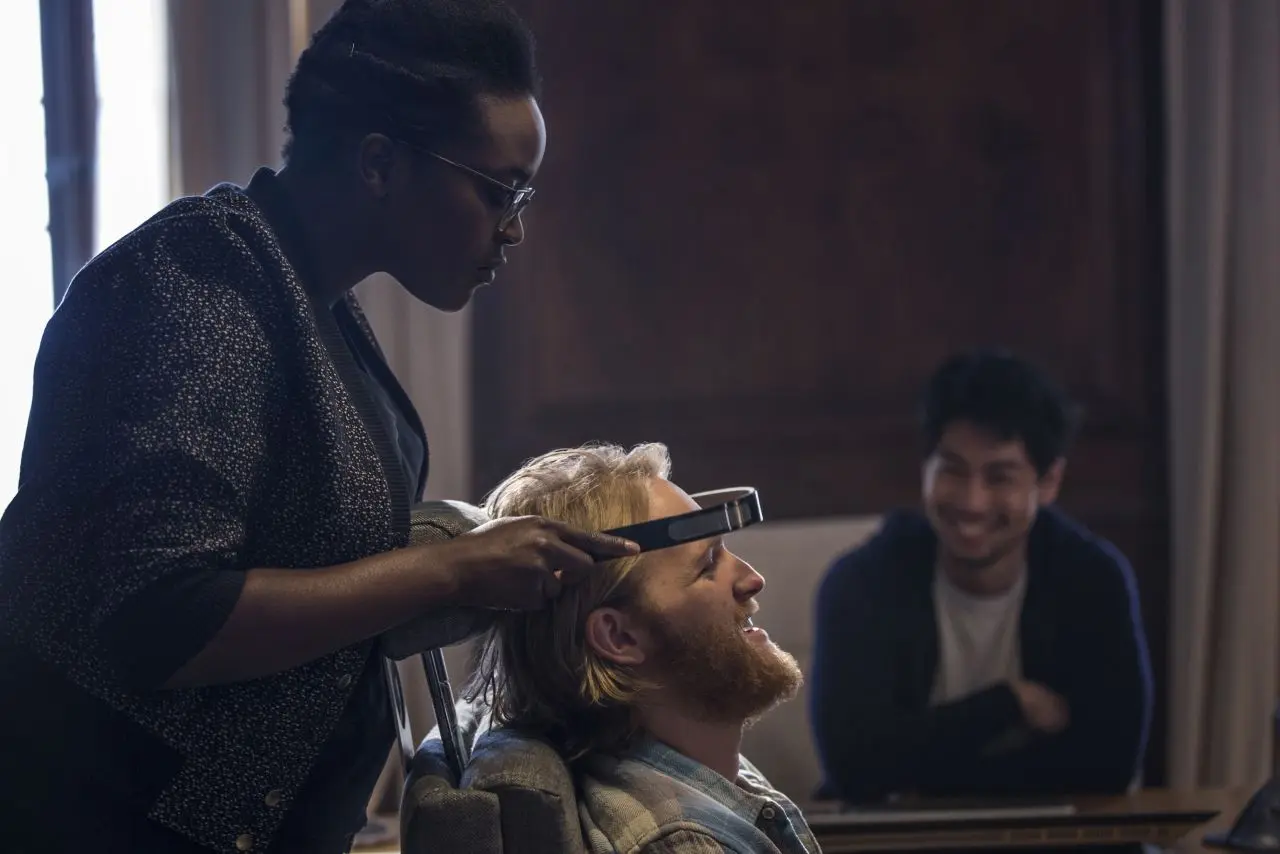
Cooper, a globe-trotting American short on cash, signs up to test a next-gen augmented-reality horror game for a Japanese studio. Technicians inject a mushroom-shaped neural implant behind his ear that wires straight into his cortex, then patch in a learning AI that reads his memories, fears and perceptions in real time. The game starts with cartoonish jump-scares overlaid on a haunted mansion, then escalates: it mines Cooper's deepest anxieties, blurs the line between hallucination and reality, and renders personalized terrors he cannot tell from the real world. The system knows him better than he knows himself, and there is no off switch he can trust.
What the episode imagines
- 🕶️❌Augmented reality gaming
- 🤖❌Neural interface entertainment
- 🔹❌Personalized psychological horror
How close are we in 2026?
The headline-grabber is how literally the games industry has chased this premise. In November 2025, Brazilian studio Pulsatrix and publisher Fireshine shipped A.I.L.A. on PC, PS5 and Xbox: you play Samuel, the sole tester of an "Artificial Intelligence Live-experience Architect" that builds horror scenarios via a cutting-edge headset and adapts each scenario to your reactions and shared thoughts. It is Playtest as a retail product, minus the brain implant. Adaptive, biometric horror is now a recognized genre, with games tuning tension to heart rate via wearables, and NVIDIA's ACE (expanded to "autonomous game characters" at CES 2025) putting on-device small language models inside titles like inZOI and NARAKA so NPCs perceive, plan and react like players.
The headset half is real too. Apple's Vision Pro and Meta's Quest 3 deliver color passthrough mixed reality good enough to overlay digital objects convincingly on your living room, with Meta holding roughly 75-80% of the headset market in 2025. What no shipping product does is render directly into your nervous system the way Cooper's implant does.
That is where brain-computer interfaces come in, and they are advancing fast but in the opposite direction. By 2025 Neuralink had implanted several patients who control cursors, play games and even moved a robotic arm by thought, while Synchron's vessel-threaded Stentrode let paralyzed users drive an Apple Vision Pro and iPhone. These devices read motor intent and stream data out; none can write a convincing hallucination back in. Valve's earlier Galea collaboration with OpenBCI pointed at affective gaming, dynamically adjusting difficulty to brain and body signals, but that is biofeedback, not the photoreal mind-injection Playtest depicts.
Key real-world developments
- A.I.L.A. ships the Playtest premise
Released November 25, 2025 by Pulsatrix and Fireshine, A.I.L.A. casts you as the lone tester of an AI that generates a personalized horror game through a near-future headset, adapting scenarios in real time to your feedback and fears.
- Neuralink patients control machines by thought
By 2025 Neuralink had implanted several people; participants moved cursors, played games, edited video and operated a robotic arm using only brain signals, with Musk targeting hundreds of implants in 2026.
- Synchron drives Apple Vision Pro from a vein
Synchron's Stentrode, threaded through the jugular near the motor cortex with no open-brain surgery, let paralyzed patients control an Apple Vision Pro and iPhone in 2025 as it pushes toward US regulatory clearance.
- Generative AI makes game worlds adaptive
NVIDIA's ACE, expanded to autonomous game characters at CES 2025, runs on-device language models in titles like inZOI and NARAKA so NPCs perceive, plan and adapt to the player, edging games toward Playtest's reactive AI.
The verdict
Closer than it sounds, and split down the middle. The mixed-reality headsets, the adaptive AI that personalizes horror to your reactions, and the biometric tuning of fear all exist and ship in 2026; A.I.L.A. is Playtest with a price tag. The decisive gap is direction: brain implants like Neuralink and Synchron read intent out of the cortex, but nothing can write a seamless, indistinguishable hallucination back in. Until BCIs can render photoreal perception rather than just decode movement, the implant's "reality you can't escape" stays fiction. Call it 45%.
Sources
- Xbox Wire: Step Inside a Horror Experience That Knows Your Fears in A.I.L.A (2025)
- Bleeding Cool: Psychological Techno-Horror A.I.L.A. Will Release This November (2025)
- NVIDIA: Redefines Game AI With ACE Autonomous Game Characters (2025)
- Next Reality: VR Headsets 2025 - Meta Quest 3 Dominates 74.6% Market (2025)
- Road to VR: Valve & OpenBCI to Launch VR Brain-computer Interface Galea (2021)
- Road to VR: Gabe Newell on Brain-computer Interfaces and gaming
Reviewed and updated by the How Close to Black Mirror editorial team on 20 June 2026. Progress scores are reasoned editorial estimates based on the cited sources, not scientific measurements.