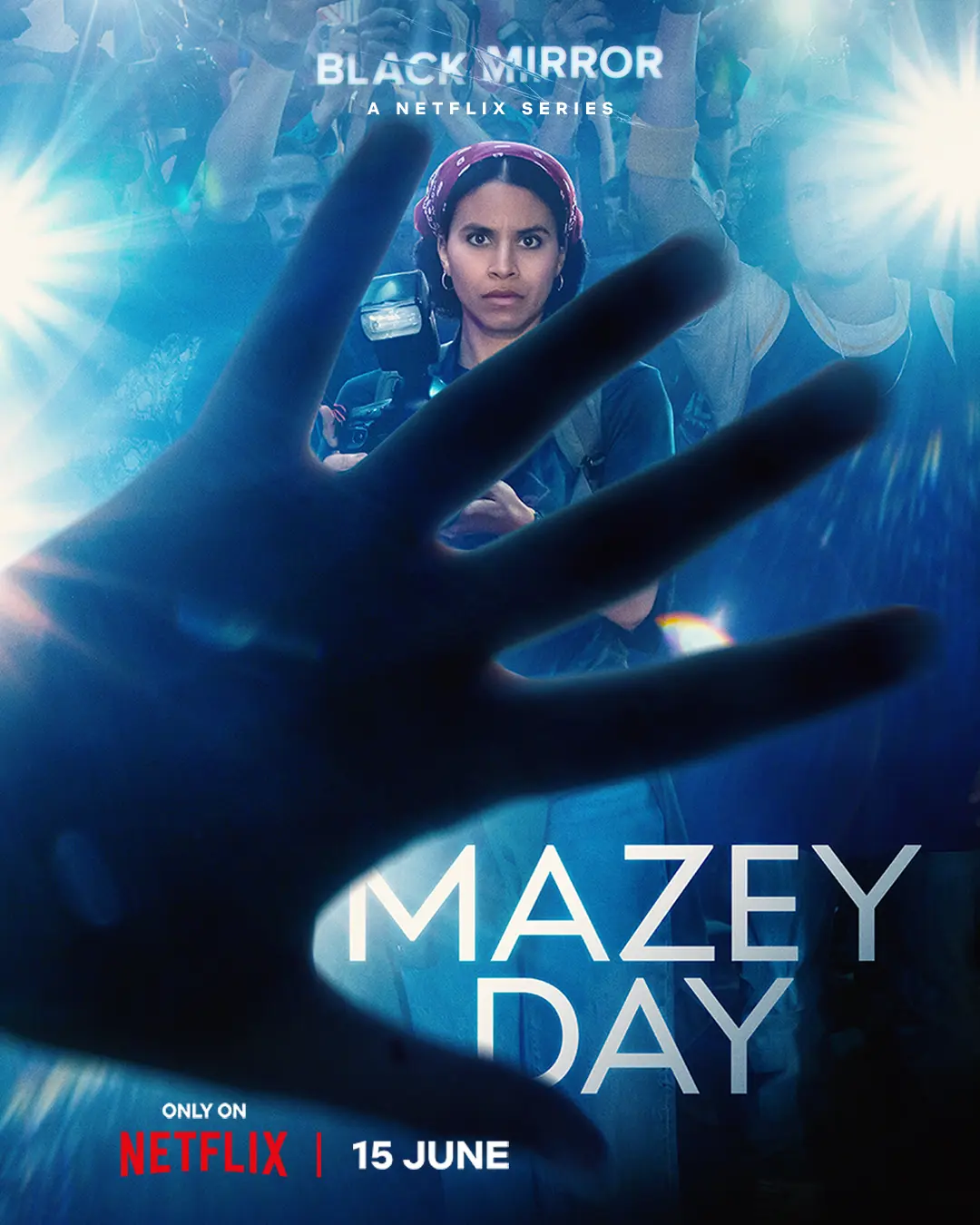
Mazey Day
The premise
Set around 2006, "Mazey Day" follows Bo, a Los Angeles paparazzo who quits the trade after a target dies by suicide, only to be lured back by a $30,000 payday for shots of troubled actress Mazey Day, who has vanished after a hit-and-run. Bo and a pack of long-lens photographers stake out, tail, and finally corner Mazey at a remote wellness retreat. The twist is supernatural — Mazey is a werewolf, and her "breakdown" is a transformation — but the real subject is the predatory celebrity-image economy: the cash bounties, the dehumanizing chase, and our appetite, as viewers, for the money shot.
What the episode imagines
- 👁️✔Celebrity surveillance
- 🔹✔Paparazzi ethics
- 📱✔Media exploitation
How close are we in 2026?
The werewolf is invented; the machine that hunts her is documented and, in 2026, mutating rather than dying. The classic 2000s paparazzi swarm has thinned — BuzzFeed News chronicled its collapse after the recession, smartphones, and stars posting their own images — but image-hunger only migrated. TMZ still runs daily "snitch"-fueled photo galleries, and the broader creator economy, valued around $250 billion and projected toward half a trillion by 2027, has turned every fan with a phone into a potential paparazzo.
The hardware Bo could only dream of is now routine and contested. California's Civil Code §1708.8 (the "anti-paparazzi" law) was expanded to bar drones from trespassing into private airspace to capture images, after celebrities including Miley Cyrus complained of camera-drones over their homes; lawyers tracking 2025 disputes note new fights over AI facial-recognition used to track stars' movements. The chase Bo runs on foot now happens via aircraft and algorithms.
The sharpest 2024–2026 echo is the collapse of trust in the image itself. In March 2024, the Associated Press, Reuters, AFP and Getty issued a rare "kill notice" retracting Catherine, Princess of Wales's Mother's Day photo after spotting digital manipulation — a globally watched scandal ("Kategate") over a doctored family picture. Worse, AI now manufactures the photos. Elon Musk's Grok generated nonconsensual sexualized deepfakes of Taylor Swift and Sabrina Carpenter, reportedly at "one per minute," prompting the federal TAKE IT DOWN Act, signed May 19, 2025.
Key real-world developments
- Agencies kill a doctored royal photo
In March 2024, AP, Reuters, AFP and Getty issued a rare "kill notice" retracting Princess Kate's Mother's Day portrait after detecting manipulation, igniting the global "Kategate" frenzy and eroding trust that any released image is real.
- Grok floods X with celebrity deepfakes
In 2025 Musk's Grok generated nonconsensual sexual deepfakes of Taylor Swift and Sabrina Carpenter; analysts told NBC News it was producing roughly one such image per minute, posted straight to X where they spread virally.
- TAKE IT DOWN Act becomes law
Signed May 19, 2025, the federal law criminalizes nonconsensual intimate images including AI deepfakes and forces platforms to remove flagged content within 48 hours, with full compliance required by May 2026.
- California restricts paparazzi drones
Amended Civil Code §1708.8 bars drones from entering private airspace to capture celebrities; 2025 disputes are now expanding to AI facial-recognition used to track stars, per entertainment-law trackers.
The verdict
"Mazey Day" has no future tech to reach — it is a period piece, and its monster is a metaphor. Judged as social commentary, we are essentially there and arguably past it. The cash-bounty chase still exists, but the predatory image economy has industrialized: drones, facial-recognition tracking, AI-edited scandals like Kategate, and machine-generated deepfakes that no longer need a real shot at all. The episode's question — our complicity in consuming a person's worst moment — is more pointed in 2026 than in 2006. The fiction is the werewolf; the appetite is documented fact.
Sources
- Wikipedia: Kategate
- NBC News: Musk’s AI chatbot Grok is still making sexual deepfakes
- Congress.gov: The TAKE IT DOWN Act (2025)
- BuzzFeed News: How the Fast Times of the Paparazzi Came to a Screeching Halt
- Hoge Fenton: Drone Photography Can Violate Anyone’s Privacy
- Poynter: What experts say happened with Princess Kate’s photo (2024)
Reviewed and updated by the How Close to Black Mirror editorial team on 20 June 2026. Progress scores are reasoned editorial estimates based on the cited sources, not scientific measurements.