The National Anthem
The premise
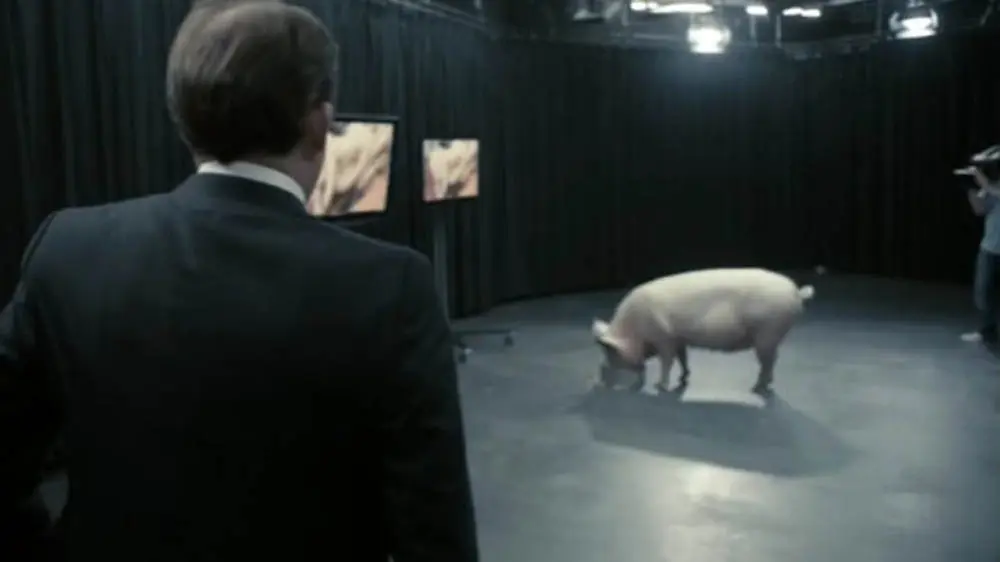
Princess Susannah, a beloved royal, is kidnapped. The ransom is not money: Prime Minister Michael Callow must have sex with a pig, broadcast live and unsimulated, by 4pm. The demand leaks onto YouTube and detonates across social media. Initially the public is sympathetic to Callow, but as the clock ticks the mood sours, jokes curdle into bloodlust, and trending hashtags become a referendum on his manhood and the state's impotence. Polls swing. Newsrooms, terrified of being seen to suppress the story, amplify it. By airtime, refusal is politically impossible. The kidnapper, it turns out, is an artist staging a comment on the herd.
What the episode imagines
- 📱✔Viral social media pressure
- 🏛️✔Real-time public opinion manipulation
- 🤖✔Political blackmail via digital means
How close are we in 2026?
The episode's real subject isn't a tech gadget; it's the mechanics of viral coercion, and those have only sharpened since 2011. The clearest 2024-2026 parallel is Nepal. After the government suspended 26 social-media platforms on 4 September 2025, a hashtag-driven "Nepo Kids" campaign exposing elite corruption exploded into mass protest; by 9 September Parliament was ablaze, Prime Minister K.P. Sharma Oli had resigned, and the ban was reversed. The state's attempt to control the feed collapsed in days, with 74 dead by 22 September. Online momentum, not institutions, set the timetable.
The sexual-humiliation-as-weapon element has also moved from fiction to statute. In July 2024 Channel 4 News found roughly 400 AI-"nudified" and doctored images of more than 30 UK politicians, including Angela Rayner, Penny Mordaunt and Priti Patel, on a single deepfake-porn site. Globally, a 2024 American Sunlight Project study logged ~35,000 instances of nonconsensual intimate imagery depicting 26 members of Congress, 25 of them women. The coercive power Brooker imagined now exists as cheap, automated software.
Governments are scrambling to respond. The US Take It Down Act (signed 19 May 2025, championed by Melania Trump) forces 48-hour takedowns; the UK's Data (Use and Access) Act 2025 made merely creating a nonconsensual intimate deepfake a crime, with Section 138 in force from 6 February 2026. James Strahler II became the first person convicted under the Take It Down Act. What no law touches is the episode's true engine: the speed at which a crowd, amplified by platforms, can override every institution meant to slow it down.
Key real-world developments
- Social-media ban topples Nepal's PM in days
After Nepal blocked 26 platforms on 4 September 2025, a viral "Nepo Kids" hashtag campaign drove protests that burned Parliament and forced PM Oli's resignation by 9 September; 74 died. Online momentum dictated state collapse.
- 30+ UK politicians hit by deepfake-porn site
In July 2024 Channel 4 News found ~400 sexually explicit doctored images of over 30 UK politicians, including Angela Rayner and Penny Mordaunt, on one site. Stella Creasy called it "about power and control," not sex.
- 26 in Congress targeted; new federal law
A 2024 American Sunlight Project study found ~35,000 nonconsensual deepfake images of 26 US lawmakers, 25 women. Trump signed the Take It Down Act on 19 May 2025, mandating 48-hour takedowns; the first conviction followed.
- UK criminalises merely making a deepfake
The Data (Use and Access) Act 2025's Section 138, in force 6 February 2026, made it an offence to create or request a nonconsensual intimate image of an adult, closing a gap where creation alone was previously legal.
The verdict
The literal scenario, a head of state coerced into a televised sex act, hasn't happened, and hopefully won't. But every component is now real: AI "nudify" tools weaponise sexual humiliation at scale, viral hashtags have toppled governments in days (Nepal), and platforms reliably convert outrage into momentum that institutions cannot brake. What Brooker dramatised as a freak event is now ambient infrastructure. The gap is one of degree and target, not mechanism. That's why this episode aged into prophecy: a high progress score is fully defensible.
Sources
- Channel 4 News: Exclusive: Top UK politicians victims of deepfake pornography (2024)
- Britannica: 2025 Nepalese Gen Z Protests
- The Markup: 1 in 6 Congresswomen Targeted by AI-Generated Sexually Explicit Deepfakes (2024)
- CNN Business: Take It Down Act signed into law (2025)
- NBC News: First person convicted under intimate-deepfake law (2025)
- Olliers Solicitors: New Law Criminalises Deepfake Creation (Data (Use and Access) Act 2025)
Reviewed and updated by the How Close to Black Mirror editorial team on 20 June 2026. Progress scores are reasoned editorial estimates based on the cited sources, not scientific measurements.