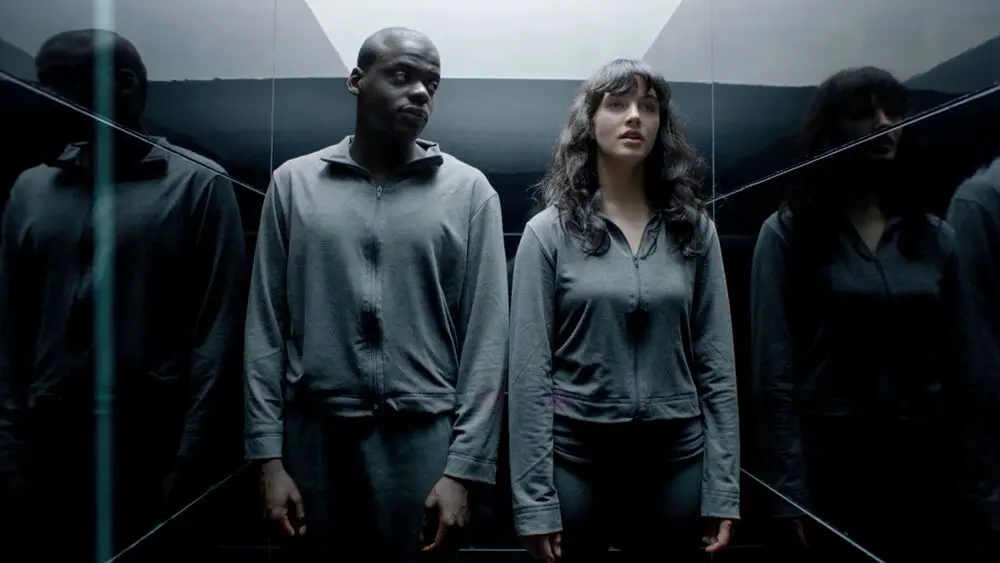
Fifteen Million Merits
The premise
In a sealed, screen-walled world, masses of workers pedal stationary bikes all day to earn "merits," a digital currency that buys food, toothpaste, and cosmetic upgrades for their cartoon avatars. Screens surround every surface, blasting ads, pornography, and game shows that you must spend merits to skip. The only visible exit from the grind is Hot Shot, a talent contest that promises stardom but actually converts genuine emotion and dissent into branded entertainment. Bing spends fifteen million merits to buy Abi an audition, watches the show metabolize her, and finally turns his own televised rage into a lucrative weekly segment. Resistance becomes content.
What the episode imagines
- 🔹✔Gamified labor economy
- 🔹✔Omnipresent digital advertising
- 🤖✔Virtual reality entertainment
- 🔹✔Commodification of talent
How close are we in 2026?
The episode's core machinery, labor turned into a scored game watched by screens, is now ordinary. Amazon runs gamified warehouse programs, MissionRacer, Dragon Duel, PicksInSpace, that turn picking and stowing into competitive games tied to a worker's real output, layered on top of pervasive productivity surveillance; the program has appeared in fulfillment centers across roughly 20 U.S. states. Uber, Lyft, and DoorDash use badges, streaks, surge bonuses, and "you're almost at your goal" nudges to extract maximum hours from drivers. A May 2025 Human Rights Watch report, "The Gig Trap," found surveyed Texas gig workers earning a median of about $5.12 an hour after expenses while opaque algorithms set their pay and could deactivate them.
The merit economy maps cleanly onto microtransactions. In-app purchases now drive roughly 95% of mobile-game spending, with global IAP revenue projected near $271 billion in 2025; "time-gating" mechanics that let you pay $0.99 to $4.99 to skip a wait or watch-an-ad-to-continue are estimated to be about 38% of mobile gaming revenue, the literal pay-to-skip dynamic Bing experiences.
The one prophecy that partly misfired is play-to-earn: the Axie Infinity dream of pedaling for crypto cratered after a $600M 2022 Ronin hack, and Web3 gaming funding fell roughly 70% in 2025. Meanwhile the Hot Shot critique, outrage and authenticity repackaged as monetized content, is now the default influencer business model.
Key real-world developments
- Amazon gamifies warehouse labor
Amazon's FC Games (MissionRacer, Dragon Duel, CastleCrafter, PicksInSpace) turn picking and stowing into screen-based competitions tied to real output, deployed across about 20 U.S. states atop existing productivity tracking.
- Gig algorithms and $5.12 wages
Human Rights Watch's May 2025 "The Gig Trap" report found surveyed Texas platform workers earning a median near $5.12/hour after expenses, governed by opaque algorithms using nudges, streaks and surge pay to maximize hours.
- Pay-to-skip microtransactions dominate
In-app purchases account for roughly 95% of mobile-game spending, with time-gating and pay-to-skip-the-ad mechanics estimated at about 38% of revenue, mirroring Bing forced to spend merits to dismiss ads.
- Play-to-earn pedaling collapsed
Axie Infinity's literal earn-by-grinding model fell apart after the $600M 2022 Ronin bridge hack; Web3 gaming venture funding dropped roughly 70% in 2025 as the play-to-earn dream faded.
The verdict
Strikingly close on substance, if not aesthetics. We don't pedal in identical cells, but gamified labor, surveillance-scored productivity, in-app currencies, and pay-to-skip ads are mainstream, and the influencer economy runs exactly on Hot Shot's trick of selling back our own outrage as content. What's missing is the totalizing enclosure: there's still an outside, still regulators and unions pushing back, and the play-to-earn version of merits actually collapsed. The episode nailed the incentives more than the architecture. Score reflects a satire whose mechanisms are largely operational.
Sources
- Gizmodo: Amazon Turns Grueling Warehouse Work Into a Video Game (2019)
- Human Rights Watch: The Gig Trap (2025)
- Bloomberg: How Uber and Lyft Gamify the Gig Economy (2022)
- Udonis: In-App Purchases Guide for Mobile Game Monetization
- Cornell Chronicle: What the crash of a play-to-earn game reveals about Web3 (2025)
Reviewed and updated by the How Close to Black Mirror editorial team on 20 June 2026. Progress scores are reasoned editorial estimates based on the cited sources, not scientific measurements.