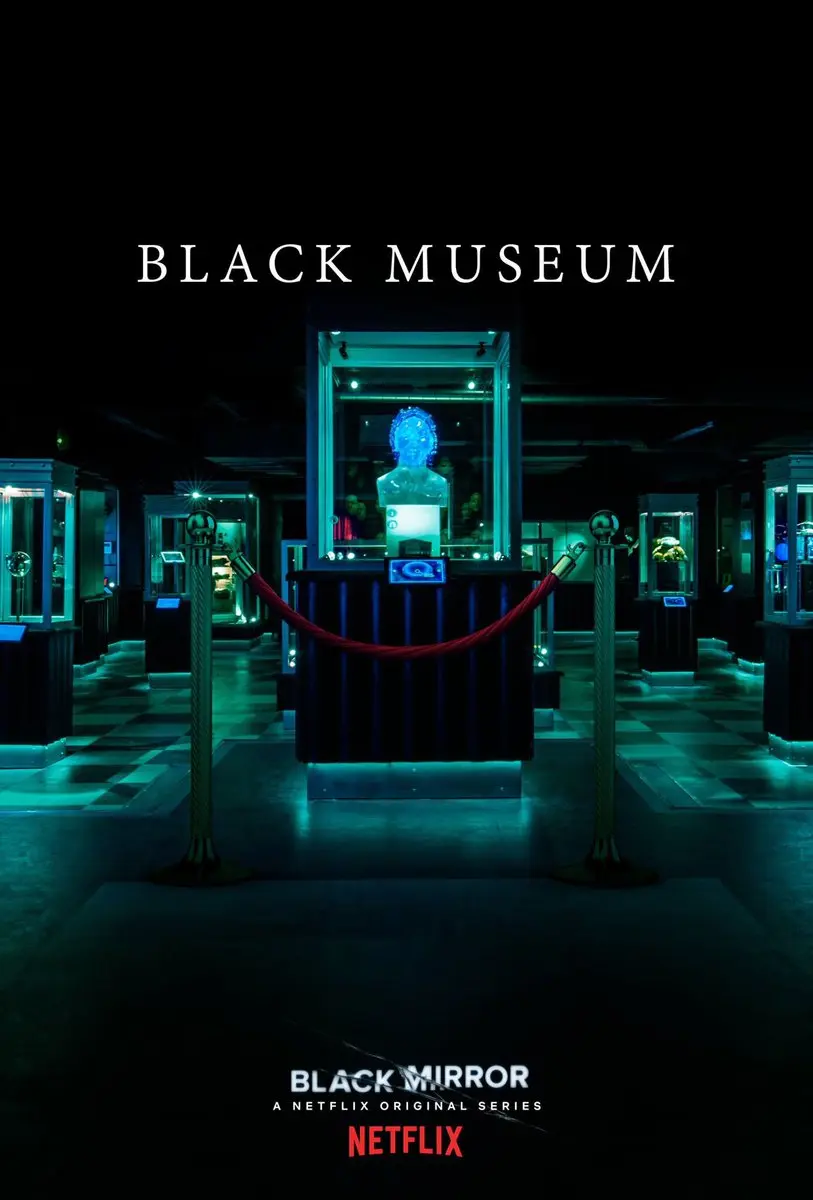
Black Museum
The premise
On a desert highway, a roadside museum of cursed tech tells three stories. A doctor gets a neural implant that lets him feel his patients' sensations to aid diagnosis, until he grows addicted to their pain and pleasure. A comatose woman's consciousness is transplanted into her husband's head, then exiled into a stuffed toy monkey that can only say two phrases. And the museum's prize exhibit is Clayton, a wrongly executed convict whose digital consciousness is trapped in a hologram so tourists can pull a lever and electrocute him for a souvenir keychain, reliving the agony of death forever.
What the episode imagines
- 🧠❌Consciousness transfer
- 🔹❌Digital punishment
- 🔹❌Medical tech abuse
How close are we in 2026?
The empathy implant is the most grounded thread. Bidirectional brain-computer interfaces that both read and write neural signals are real: a 2025-2026 fully implantable system let a paralysed patient drive a robotic exoskeleton by thought while receiving artificial walking sensations, hitting roughly 92% accuracy in both directions, and Neuralink's stated roadmap explicitly includes sensory feedback so users can "feel" through robotic limbs. Closed-loop neuromodulation for chronic pain, reviewed in Cell Reports Medicine in 2024, pairs a pain-detection arm with precisely timed stimulation. Reading and replaying another person's specific pain, as Dawson's implant does, remains fiction, but the hardware that senses and writes sensation now exists in clinics.
The digital-resurrection thread is uncomfortably current. A "digital afterlife industry" of griefbots and deadbots now lets almost anyone revive a deceased person from their data; in 2024 Cambridge ethicists at the Leverhulme Centre, led by Katarzyna Nowaczyk-Basinska, called for safeguards against unwanted "hauntings" by chatbots of the dead. In August 2025, ex-CNN journalist Jim Acosta interviewed an AI avatar of Joaquin Oliver, a teenager killed in the 2018 Parkland shooting, built by his parents from his writings and voice, igniting fierce backlash.
Clayton's tortured digital consciousness intersects the real AI-welfare debate. In 2024 Anthropic hired Kyle Fish as its first AI-welfare researcher; by 2025 Claude Opus could end abusive chats, and a representative survey found 20% of Americans already believe AI is sentient.
Key real-world developments
- Two-way BCI restores walking sensation
A 2025-2026 fully implantable bidirectional brain-computer interface let a paralysed user control a robotic exoskeleton by thought while receiving artificial sensory feedback, reaching about 92% accuracy in both movement decoding and sensation, a step toward Dawson's empathy implant.
- Cambridge warns of deadbot 'hauntings'
In May 2024, ethicists at Cambridge's Leverhulme Centre, including Katarzyna Nowaczyk-Basinska, urged safeguards for the booming 'digital afterlife industry,' warning griefbots of the dead could become an overwhelming emotional weight that survivors cannot switch off.
- AI avatar of dead Parkland teen
In August 2025, journalist Jim Acosta interviewed an AI avatar of Joaquin Oliver, killed in the 2018 Parkland shooting, recreated by his parents from his online writing and voice for a gun-control message, sparking widespread public backlash.
- Companies take AI suffering seriously
Anthropic appointed AI-welfare researcher Kyle Fish in 2024; by August 2025 some Claude models could exit abusive conversations to reduce hypothetical harm, the first corporate acknowledgement of a Clayton-style suffering question.
The verdict
Each thread has a real foothold. Implants that sense and write touch and pain are in clinics, the digital-afterlife industry is reviving the dead from their data, and labs are openly debating whether AI can suffer. What is missing is the hard part: there is no way to copy a human consciousness into another skull, a toy, or a hologram, and no evidence any digital system actually experiences pain. Black Museum's horror is less about the tech existing than about who controls it and the cruelty it enables, and those incentives are very real. Closer than comfortable on capability, still firmly fiction on transferable minds.
Sources
- University of Cambridge: Call for safeguards to prevent unwanted 'hauntings' by AI chatbots of dead loved ones (2024)
- Washington Post: Jim Acosta sparks fury with 'interview' of dead Parkland teen's AI avatar (2025)
- Cell Reports Medicine: Closed-loop neural interfaces for pain: Where do we stand? (2024)
- Medical Xpress: A two-way brain interface could help restore walking after paralysis (2026)
- 80,000 Hours: Kyle Fish on the most bizarre findings from 5 AI welfare experiments
- Springer, Philosophy & Technology: Griefbots, Deadbots, Postmortem Avatars (2024)
Reviewed and updated by the How Close to Black Mirror editorial team on 20 June 2026. Progress scores are reasoned editorial estimates based on the cited sources, not scientific measurements.